
How Managers Can Enhance Trust
How to stimulate interpersonal trust in organizations? How can performance management contribute to trust? And, can other types of management control also enhance interpersonal trust? These questions are addressed in our recent study amongst healthcare managers, as published in The British Accounting Review (open access). In this blog, the authors highlight our three key findings.
Performance measurement received much attention from accounting and management scholars in the past decades. It can help address typical agency problems and has the potential to enhance, for instance, role clarity and motivation. At the same time, performance measurement may lead to stress, gaming, indicatorism and other unfavorable effects (for an overview, see Van der Kolk, 2024). Summarizing a vast body of literature on this topic, we see that conditions matter for the (un)favorable effects of performance measurement. Also, the inherent qualities of the performance measurement play a noticeable role.

Study background and setting
Our study focusses on the healthcare sector. Performance measurement, and management control practices in general, have been met ‘with antipathy’ in healthcare organizations in the recent past (cf. Carr & Beck, 2020, p. 327). Control has been perceived as curbing the autonomy of professionals and is generally not met with great enthusiasm by professionals. The healthcare setting is therefore an ideal setting to see whether management control that uses metrics (i.e., performance management) can yield positive results.
To study the question how performance management can impact trust and performance, we conducted a survey study. One-hundred-fifty-two middle managers from Dutch healthcare organizations filled out our questionnaire that included constructs and items on performance management, other forms of management control, metric quality, trust, and unit performance. We used self-determination theory to develop our hypotheses and analyzed our data using structural equation modelling (SEM) and ordinary least squares (OLS) models. Three lessons can be drawn from our study.
Lesson 1: PM in and of itself does not impact trust – metric quality matters!
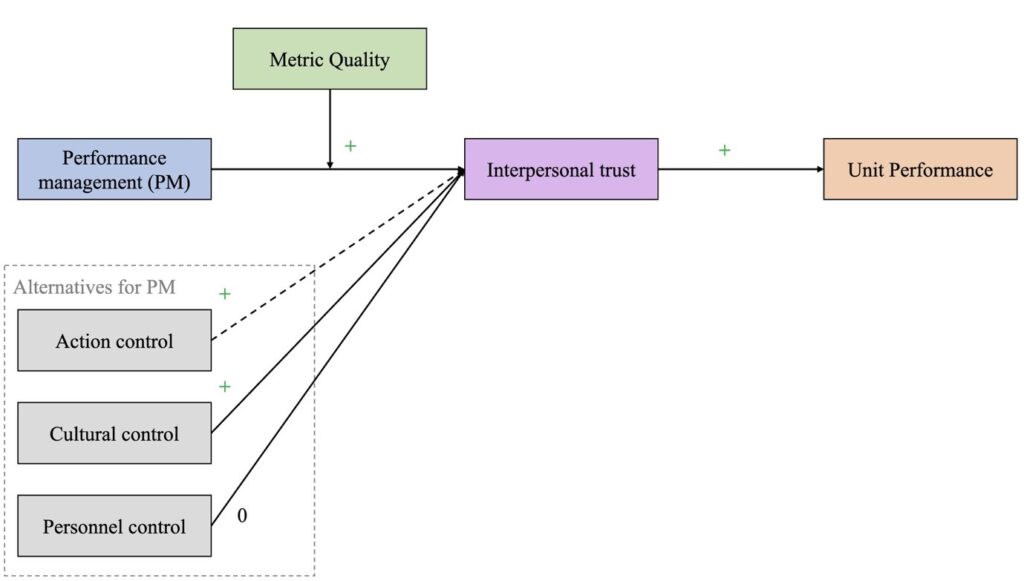
From our findings, it follows that the use of performance management itself does not significantly impact trust in healthcare settings. The relation between performance management and trust is not significant in both the SEM and OLS models. However, the combined effect of higher levels of metric quality and more use of performance management has a positive effect on interpersonal trust. This implies that performance management likely only generates a positive impact on trust if metric quality is high.
But what’s metric quality? We measured metric quality using a 5-item construct based on prior research. Metric quality is high when metrics accurately pick up performance (accuracy), when they pick up real changes and can be impacted by the unit (sensitivity), and when they include objective and verifiable performance measures (verifiability). When metric quality is high, it is more likely that performance management practices yield positive effects on interpersonal trust and performance, according to our findings.
Lesson 2: Other types of control can also enhance trust
We also report that action control and cultural control can positively impact interpersonal trust. We explain the surprising finding that action control positively impacts trust, by pointing to the possibility that control mechanisms mediate in the development of a trusting and collaborative relationship.
Cultural control’s positive impact on trust can be explained by the importance of shared norms and values and frequent interactions with colleagues, e.g. by offering and receiving feedback. That seems to contribute to higher levels of interpersonal trust in our setting.
Lesson 3: Trust is positively associated with performance
Lastly, our data shows that high levels of interpersonal trust are associated with high levels of unit performance. In healthcare settings, delivering high-quality care is often the result of cooperation between a (large) number of professionals. We show that trust among professionals is positively related to unit performance.
Conclusion
We started this blog by posing the question ‘How can performance management contribute to trust?’ The answer is, as always: it depends. To be more specific: yes, our findings suggest that trust can be enhanced through performance management practices, but only when the metrics used are of sufficient quality.
In other words, our study highlights that metric quality matters. So, managers who wish to enhance trust and performance in their organizations should care about the accuracy of measures (they shouldn’t be messy), the sensitivity of the measures (they should respond well to real changes in performance), and the verifiability of the measures (they should include objective and verifiable information).
References
- Carr, M., & Beck, M. P. (2020). Clinician responses to management control: Case evidence from a university hospital during the fiscal crisis. Financial Accountability & Management, 36(3), 319–337.
- Van Elten, H.J. and B. van der Kolk (2024), Performance Management, Metric Quality, and Trust: Survey Evidence from Healthcare Organizations, The British Accounting Review, forthcoming. DOI: 10.1016/j.bar.2024.101511
- Van der Kolk, B. (2024), The Quantified Society: How our obsession with performance measurement shapes the world we live in. Business Contact, Amsterdam.