



Could Distributed Peer Review Better Decide Grant Funding?
The landscape of academic grant funding is notoriously competitive and plagued by lengthy, bureaucratic processes, exacerbated by difficulties in finding willing reviewers. Distributed […]
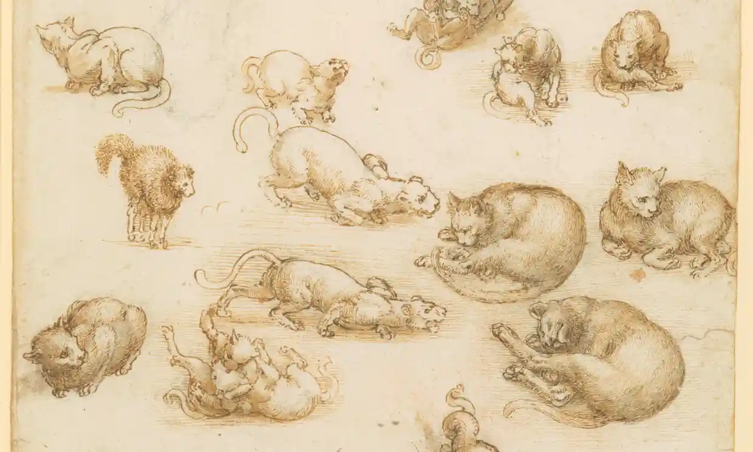
Stoyan V. Sgourev, possibly the only management professor teaching (and indulging in) art history, argues that many of the key principles that guided the evolution of painting during the Italian Renaissance can be usefully applied to the domain of academic writing. Leonardo quite likely never intended to articulate advice on writing as an intellectual activity, but Stoyan borrows generously from his style and writings in formulating a number of basic principles that can help connect with the reader in a similar way to his paintings.

Jargon, a specialized language or set of expressions used by a specific group, is by its nature exclusionary, so it’s likely no surprise that scientific, technical or legal jargon may leave outsiders in the cold. A series of studies from researchers at Ohio State University suggests that jargon may turn off people well beyond an offending passage, and that one popular way to soften any harm – using jargon but immediately defining it – may not work.
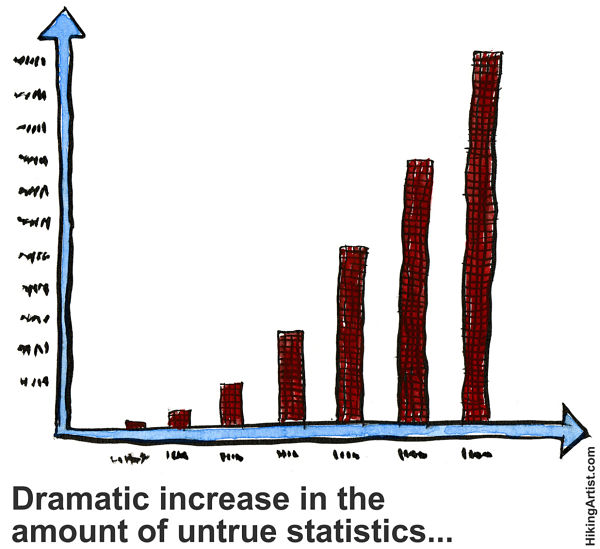
Statistics are not the final objective answer to things. They can be interpreted in lots of different ways, even when none of those ways is wrong per se. That opens up a space for public debate, which is good news, but it also opens up a space where statistics can either be lauded as the truth (when they are not), or dismissed out of hand as ‘biased’.

If you were going to create an encyclopedia about “mass media,” your first task likely would be to define both words in the term. Doing so was immeasurably easier in the 1920s, when the term “mass media” first started making the rounds, but it’s grown corresponding harder as both the popular conception of ‘mass’ has mutated and the very media itself has evolved from purely paper to heavily broadcast to OMG online.
The academic publishing paradigm is changing, driven in large part by calls for open access to publicly funded research. In this second of two parts, the university librarian for the University of North Carolina at Chapel Hill explains the thinking behind of a pilot program UNC inked with a major academic publisher.

The academic publishing paradigm is changing, driven in large part by calls for open access to publicly funded research. In this first of two parts, SAGE Publishing’s vice president of open research explains the genesis of a pilot program his company has inked with a major U.S. research university.

As the educational reading landscape shifts to digital, Naomi Baron argues we must find proven strategies to help students become more aware of the best ways to read and study online – especially as regular printed textbooks gradually begin to disappear.
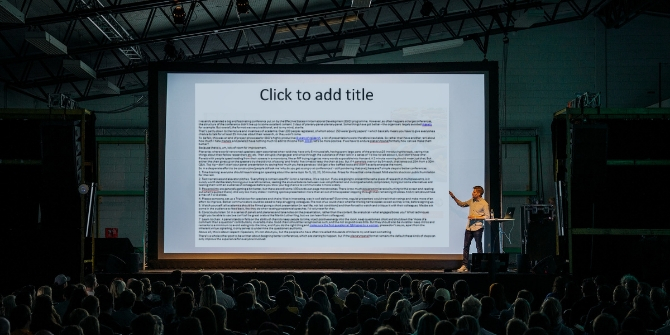
The default format for most academic conferences is a plenary followed by panel presentations. If we can’t revolutionize conference design, we can at least consider Duncan Green’s seven tips for improvement (electric shocks optional).

The Royal Swedish Academy of Sciences has awarded this year’s Nobel Prize in Economic Sciences to the American economists Robert E. Hall […] Four Americans working in the social and behavioral sciences are among the 20 people named MacArthur Fellows this year. Recipients may be […] Euan Adie, the founder of Altmetric and later of Overton, discusses the reasons the led to Overton’s focus on showing researchers how […] The following is an adapted extract from The Cultural Industries, fifth edition, by David Hesmondhalgh. The increasing presence of information technology (IT) […] Developers of AI data centers have a public trust problem. According to multiple surveys, a majority of Americans say they would oppose […] I was adding some final flourishes on the topic of ‘iatrocracy’ to my forthcoming book with Natewindé Sawadogo – Sickness and Social […]
EXPLORE
Impact

Economic Peaks, Troughs and This Year’s Nobelists in Economics
READ MORE
Four From Social Science World Receive 2026 MacArthur Fellowships
READ MORE

Quick Insight: Euan Adie on Getting Academics Credit for Their Impact
READ MORE
Innovation

IT Giants and Their Operations: Should We Be Concerned?
READ MORE

What We Miss When We Study Public Trust with Surveys Alone
READ MORE

AI and ‘Iatrocracy’ – A Cautionary Tale
READ MORE