


Could Distributed Peer Review Better Decide Grant Funding?
The landscape of academic grant funding is notoriously competitive and plagued by lengthy, bureaucratic processes, exacerbated by difficulties in finding willing reviewers. Distributed […]
The enterprise had experienced governance issues in some territories and efforts to roll out a global ethical conduct program proved less effective in certain parts of the world than in others. This could not just be ascribed to local execution or lack thereof, so I became intrigued to understand and explain this.
Back in the day, I attended one of those schools where male character was thought to be formed by endless afternoons of […]

Co-authorship is now for many social science disciplines the default mode of academic authorship. Reflecting on this, Helen Kara provides insights and advice for authors looking to co-write and co-publish in an ethical way.

A new article in PS: Political Science & Politics analyses psychological science in the aftermath of a “replication crisis” and “credibility revolution” and explicitly examines “what social scientists can learn from this story.”

How can we ensure that, when power shifts again, the U.S. government remains fundamentally grounded in empirical reality and committed to pursuing policies that are informed by the best available science?

(Over)consumption, climate change and working from home. These are a few of the concerns at the forefront of consumers’ minds and three […]

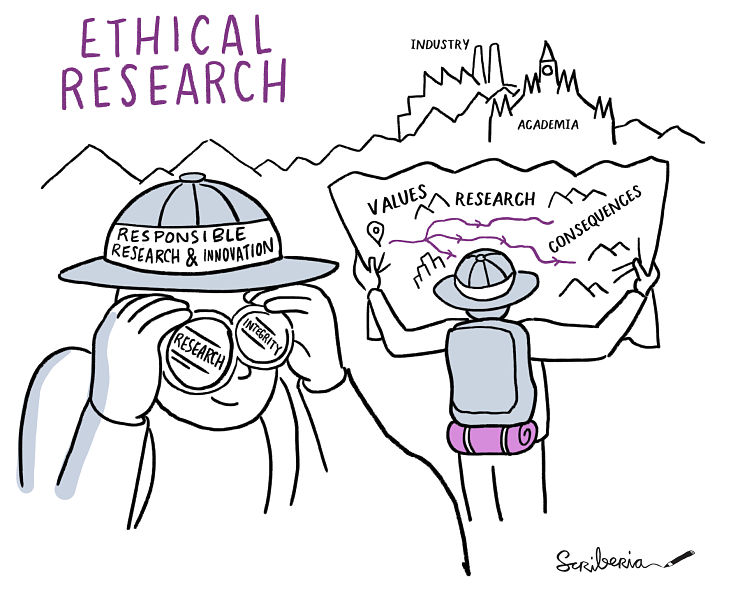
Ethical research involves much more than a pre-study review or forms to explain how the study adheres to the institution’s rules about […]

While journalism might at times be seen as a sort of ‘ethnography lite,’ when it comes to checking out the field reporter’s facts it’s much more of a heavy hitter.

The Royal Swedish Academy of Sciences has awarded this year’s Nobel Prize in Economic Sciences to the American economists Robert E. Hall […] Four Americans working in the social and behavioral sciences are among the 20 people named MacArthur Fellows this year. Recipients may be […] Euan Adie, the founder of Altmetric and later of Overton, discusses the reasons the led to Overton’s focus on showing researchers how […] The following is an adapted extract from The Cultural Industries, fifth edition, by David Hesmondhalgh. The increasing presence of information technology (IT) […] Developers of AI data centers have a public trust problem. According to multiple surveys, a majority of Americans say they would oppose […] I was adding some final flourishes on the topic of ‘iatrocracy’ to my forthcoming book with Natewindé Sawadogo – Sickness and Social […]
EXPLORE
Impact

Economic Peaks, Troughs and This Year’s Nobelists in Economics
READ MORE

Four From Social Science World Receive 2026 MacArthur Fellowships
READ MORE

Quick Insight: Euan Adie on Getting Academics Credit for Their Impact
READ MORE
Innovation
IT Giants and Their Operations: Should We Be Concerned?
READ MORE

What We Miss When We Study Public Trust with Surveys Alone
READ MORE

AI and ‘Iatrocracy’ – A Cautionary Tale
READ MORE












































































