


Could Distributed Peer Review Better Decide Grant Funding?
The landscape of academic grant funding is notoriously competitive and plagued by lengthy, bureaucratic processes, exacerbated by difficulties in finding willing reviewers. Distributed […]

The future of the academic monograph has been questioned for over two decades. At the heart of this ‘monograph crisis’ has been a publishing industry centred on the print publication of monographs and a failure and lack of incentives to develop business models that would support a transition to open digital monographs. In this post Mike Taylor argues that if monographs are to be appropriately valued, there is a pressing need to further integrate monographs into the digital infrastructure of scholarly communication. Failing this, the difficulty in tracking the usage and discovery of monographs online, will likely make the case for justifying further investment in monographs harder.
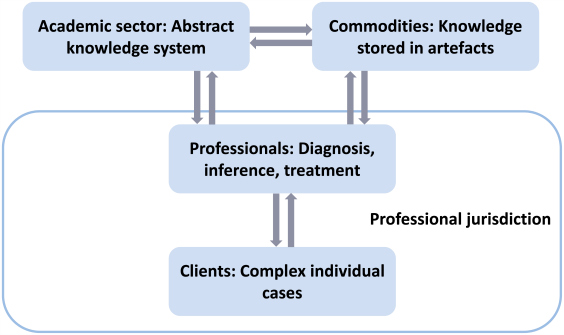
Arlette Jappe, David Pithan and Thomas Heinze find that the growth in the volume of ‘evaluative citation analysis’ publications has not led to the formation of an intellectual field with strong reputational control. This has left a gap which has been filled by commercial database providers, who by selecting and distributing research metrics have gained a powerful role in defining standards of research excellence without being challenged by expert authority.

Burned out by the hamster-wheel of academe and the regime of metrics, John Postill decided the tonic would be to write a spoof spy thriller about a Spanish nerd with a silly name who moves to London in 1994 and accidentally foils a terrorist plot by an evil anthropologist.
A new survey of university faculty finds that the idea of altmetrics – using something aside from journal citations as the measure of scholarly impact – has made less headway among faculty than might be expected given the hoopla surrounding altmetrics. These new measures are the most familiar in the social science community (barely) and least familiar in the arts and humanities (dramatically so).
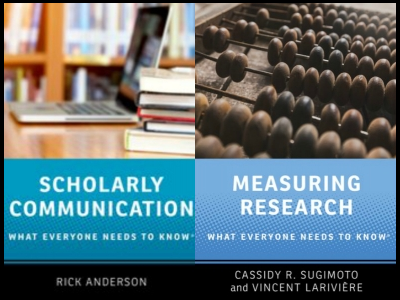
Academics are required to not only find effective ways to communicate their research, but also to increasingly measure and quantify its quality, impact and reach. In Scholarly Communication: What Everyone Needs to Know, Rick Anderson puts us in the picture. And in Measuring Research: What Everyone Needs to Know, Cassidy Sugimoto and Vincent Lariviere critically assess over 20 tools currently available for evaluating the quality of research.
To end his trilogy of articles on the research metric system (and Google Scholar in particular), Louis Coiffait explores what improvements could be made.

The active use of metrics in everyday research activities suggests academics have accepted them as standards of evaluation. Yet when asked, many academics profess concern about the limitations of evaluative metrics and the extent of their use. Why is there such a discrepancy between principle and practices?
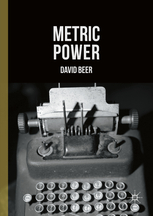
In Metric Power, David Beer examines the intensifying role that metrics play in our everyday lives, from healthcare provision to our interactions with friends and family, within the context of the so-termed data revolution. This is a book that illustrates our growing implication in, and arguable acquiescence to, an increasingly quantified world, but, Thomas Christie Williams asks, where do we locate resistance?

Four Americans working in the social and behavioral sciences are among the 20 people named MacArthur Fellows this year. Recipients may be […] Euan Adie, the founder of Altmetric and later of Overton, discusses the reasons the led to Overton’s focus on showing researchers how […] Here’s a couple of quick questions for you. What is the smallest of the eight discipline-based directorates at the United States’ National […] I was adding some final flourishes on the topic of ‘iatrocracy’ to my forthcoming book with Natewindé Sawadogo – Sickness and Social […] How is AI changing the shape and space of higher education? Critical thinking continues to rank highly among key skills and attributes […] My colleagues and I recently spoke with a group of talented, interesting students who just completed their first year of college about […]
EXPLORE
Impact
Four From Social Science World Receive 2026 MacArthur Fellowships
READ MORE
Quick Insight: Euan Adie on Getting Academics Credit for Their Impact
READ MORE

NSF’s Embattled SBE Directorate Shown as Agency’s Policy Heavyweight
READ MORE
Innovation

AI and ‘Iatrocracy’ – A Cautionary Tale
READ MORE

The Critical Student: How GenAI Reshapes Critical Skills and Higher Education’s Role Preparing Students For It
READ MORE

AI Doesn’t Drive Student Cheating. It Just Hitches a Ride
READ MORE